Dual Dressed Black Holes as the End Point of the Charged Superradiant Instability in N = 4 Yang Mills
Motivation and setup
A black hole in anti-de Sitter space can lose stability when it becomes favorable to transfer charge from its horizon to material outside it. The reflecting asymptotic geometry allows emitted excitations to remain in the system. The question is then thermodynamic as well as dynamical: at fixed total energy and charges, what configuration replaces the unstable black hole? This paper investigates that question in type IIB string theory on \(AdS_5\times S^5\), the gravitational dual of strongly coupled \(\mathcal{N}=4\) Yang–Mills theory.
Earlier descriptions emphasized charged scalar condensates and hairy black holes in a five-dimensional gauged-supergravity truncation. A consistent truncation permits solutions within its retained fields, but does not guarantee stability against all fields of the full theory. The ten-dimensional theory contains an infinite tower of charged excitations. The paper shows that large dual giant gravitons provide an instability channel that is absent from the restricted description. In particular, previously proposed hairy endpoints can themselves discharge into these objects.
A dual giant is a D3-brane expanded into the anti-de Sitter directions while carrying angular momentum on the internal sphere. The proposed endpoint contains a central black hole and one, two, or three very large dual giants. Each giant carries charge of order \(N^2\) and lies at a radial position of order \(\sqrt{N}\) in AdS units. Their large separation makes a weakly interacting composite possible even though the total energy outside the horizon is macroscopic.
The charge and energy bookkeeping is written in equation (43):
\[ \begin{split} &N_{\rm eff}=N-m\\ &E^{BH}=E^{\rm tot}-\sum_{i=1}^{3}Q_i^D\\ &Q_i^{BH}=Q_i^{\rm tot}-Q_i^D\\ &J_i^{BH}=J_i^{\rm tot}. \end{split} \]
Here \(m\) is the number of dual giants, \(Q_i^D\) their charges, and \(N_{\rm eff}\) the five-form flux seen by the central black hole. The small flux reduction is important for selecting how many giants occur, even though it is subleading in the leading large-\(N\) thermodynamics.
Construction and main results
The dominant entropy comes from the core horizon. Its dependence on the remaining energy, charges, angular momenta, and effective flux is summarized in equation (44):
\[ S_{BH}=N_{\rm eff}^{2}\,s_{BH}\left(\frac{E^{BH}}{N_{\rm eff}^{2}},\frac{Q_i^{BH}}{N_{\rm eff}^{2}},\frac{J_j^{BH}}{N_{\rm eff}^{2}}\right). \]
At fixed total charges, the preferred division between core and dressing maximizes this entropy. The leading derivative, equation (48), takes a particularly transparent form:
\[ \frac{\partial S_{BH}}{\partial Q_i^D}=\beta(\mu_i-1),\qquad Q^{BH}<Q^{\rm tot}. \]
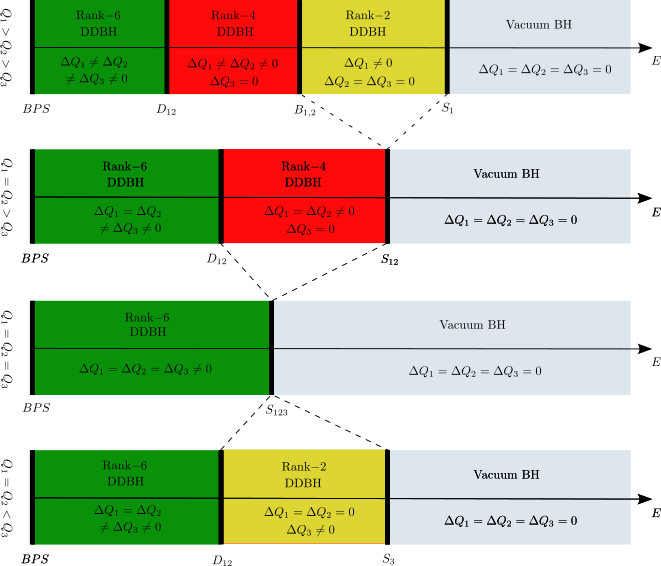
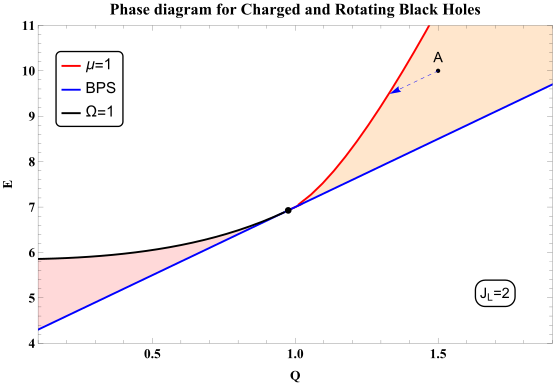
The inverse temperature is \(\beta\), and \(\mu_i\) is the core chemical potential. If a potential exceeds unity, moving the corresponding charge into a dual giant increases entropy. An interior equilibrium therefore pins that potential to unity. Channels in which no giant is present instead satisfy the appropriate endpoint condition with potential below unity. Depending on how many channels are occupied, the resulting dual dressed black holes have rank two, four, or six.
The leading entropy does not determine the number of giants by itself. At the next order, the loss of effective flux reduces the central entropy. Within the proposed family, this favors the smallest number of giants needed to carry the dressing: one, two, or three in the respective phases. The paper analyzes both unequal-charge nonrotating configurations and equal-charge rotating configurations, displaying phase boundaries and competition with rotationally dressed grey galaxies.
The canonical description reaches the same threshold from another direction. A dual giant becomes macroscopically occupied when a chemical potential approaches unity closely enough. Equation (56) gives the relevant large-\(N\) scaling:
\[ \mu_i=1-\frac{\chi_i}{N^2}. \]
The paper also studies the quantum mechanics of a giant near the black hole, including potential tunneling into the horizon. The threshold picked by that analysis agrees with the thermodynamic equilibrium condition. Approximate ten-dimensional solutions incorporate the gravitational backreaction of the large giants: their contribution to the asymptotic charges is significant, while the metric perturbation can still be handled linearly in the appropriate large-\(N\) regime.
Interpretation and limits
The main physical lesson is that a black hole need not store all of a state’s conserved charges behind its horizon. A relatively simple core can coexist with distant objects carrying a substantial share of the charge. Holographically, this enlarges the candidate equilibrium phases of a familiar gauge theory. It also shows why a solution stable inside a consistent truncation may fail to describe equilibrium in the full string-theory spectrum.
The proposed phase dominance is a conjecture supported by the construction and thermodynamic analysis, rather than a proof excluding every possible state. The approximation uses large \(N\), strong coupling, a small number of widely separated dual giants, and controlled inverse-\(N\) corrections. The paper explicitly leaves open the possibility of other nonlinear solutions with greater entropy. Stability against the analyzed tunneling channel does not by itself establish stability against all conceivable perturbations.
The displayed phase diagrams also omit Gregory–Laflamme instabilities and the associated black holes localized in ten dimensions. Their proposed interpretation is therefore restricted to regimes where the participating five-dimensional cores are stable against that effect. Completing the full charge-and-angular-momentum phase diagram, understanding the corresponding microscopic states, and constructing more general nonlinear dressed solutions remain further tasks. These qualifications preserve the distinction between the explicit approximate solutions and the broader equilibrium picture they motivate.
Source: arXiv:2409.18178, especially sections 1, 3, 5–7; equations (43), (44), (48), and (56); original Figures 1 and 5.
Related work: Supersymmetric grey galaxies and dual dressed black holes · Supersymmetric ground states in AdS₄.