Phases of Supersymmetric Ground States in AdS₄
Motivation and setup
Supersymmetry places a lower bound on the energy of a state with specified charges. States that saturate it are BPS states, the supersymmetric ground states in their charge sector. Black holes account for enormous numbers of such states, yet familiar regular BPS black holes do not exist at every allowed charge. This work asks what fills the rest of the phase diagram, and how these additional states affect the protected count called the superconformal index.
The setting is supergravity on \(AdS_4\times S^7\), restricted to four electric charges equal in pairs. There are consequently two independent electric charges, \(Q_1\) and \(Q_2\), and one angular momentum, \(J\). The BPS energy bound is equation (1):
\[ E\ell\geq J+2(Q_{1}\ell+Q_{2}\ell)~. \]
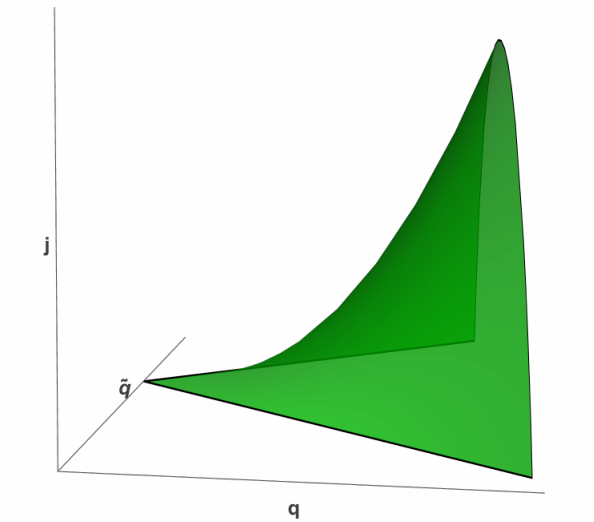
Here \(\ell\) is the AdS radius. Saturating this linear inequality is necessary for supersymmetry, but a regular single black hole must also obey a nonlinear charge relation. After rescaling charges by the large-\(N\) parameter \(k=\ell^2/(2G)\), the paper uses densities \(q_1,q_2,j\), their sum \(q\), and difference \(\tilde q\). The nonlinear relation becomes the “black hole sheet,” equation (44):
\[ \displaystyle j=j_{c}(q,\tilde{q})=q\left(\sqrt{1+4\left(q^{2}-\tilde{q}^{2}\right)}-1\right)~. \]
This sheet is a surface in a three-dimensional charge space. It does not fill the physical region. Its geometry therefore exposes the central puzzle: generic supersymmetric charge sectors cannot be described by an isolated member of the known black-hole family. The paper proposes that they instead contain a black-hole core accompanied by another component carrying the remaining charge.
Construction and results
The construction assumes a two-component system whose energy and charges add at leading order. One component is a BPS black hole; the other is termed a gas. The gas carries macroscopic charge but negligible leading entropy, so the total entropy comes from the core. This is a thermodynamic prescription supported by related constructions, rather than an explicit construction of every proposed supersymmetric geometry.
Given total charges, the allowed cores lie on the black hole sheet and must leave nonnegative charges for the gas. The dominant candidate is found by maximizing the core entropy over that allowed set. On the sheet, the entropy density takes the simple form in equation (45):
\[ s_{BH}(j,q)=\pi\frac{j}{q}~. \]
This constrained optimization produces distinct phases. On the overrotating side, called Region I, the entropy is greatest when the core retains all electric charge and the gas carries the excess angular momentum. This has the character of a grey galaxy, with angular momentum stored far from the central black hole.
On the overcharged side, Region II, the optimum places all angular momentum in the core while the gas carries electric charge. There are two cases. In Region IIa the core can reach equal electric charges, and the gas absorbs the charge imbalance. In Region IIb the positivity constraints prevent that equal-charge core; the optimum instead has gas carrying only one of the two electric charges. These charged configurations are motivated by dual giant gravitons, with an \(M2\)-brane interpretation in this compactification.
The superconformal index introduces another optimization. Because its chemical potentials obey a supersymmetric constraint, it resolves combinations of charges rather than all three charges independently. In the paper’s density variables, an index line has fixed \(\zeta=q+j\) and \(\tilde\zeta=\tilde q\). Each physical line intersects the black hole sheet once, but this intersection need not supply its largest entropy.
Assuming that cancellations in the signed index do not remove the leading entropy maximum, the paper compares configurations along each line. For nonnegative \(\tilde\zeta\), its result is equation (126):
\[ s_{\mathcal{I}}(\zeta,\tilde{\zeta})=\begin{cases}s_{X}(\zeta,\tilde{\zeta})&,~~{\rm if~~}\tilde{\zeta}\leq\frac{1}{2}\\ s_{max}(\zeta,\tilde{\zeta})&,~~{\rm if~~}\tilde{\zeta}>\frac{1}{2}\end{cases} \]
The quantity \(s_X\) is the entropy of the pure black hole at the intersection; \(s_{max}\) is the larger two-component maximum. Exchanging the electric charges extends the transition to negative \(\tilde\zeta\). Thus sufficiently unequal charges change the phase dominating the predicted index.
Interpretation and limits
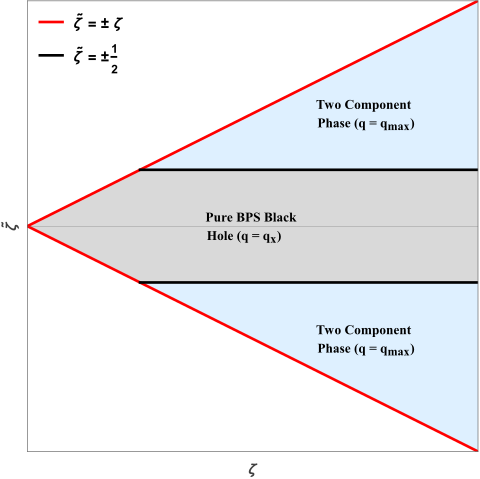
The distinction between two phase diagrams matters. The ground-state diagram fixes all conserved charges; the index diagram groups states along charge-space lines. A two-component configuration can dominate the latter even though a pure black hole exists elsewhere on the same line. Agreement between a black-hole entropy calculation and an index calculation therefore has a restricted domain, rather than establishing that all typical supersymmetric states are isolated black holes.
The paper also studies complex Euclidean BPS black holes and their chemical potentials. The loss of a convergent statistical interpretation tracks the predicted onset of the two-component index phase. However, the Kontsevich–Segal–Witten criterion for allowable complex metrics remains satisfied in the unstable region. In this example that geometric criterion is too weak to diagnose the relevant transition.
The results retain two important qualifications. First, the detailed existence and supersymmetry of the proposed gas-plus-core configurations require further work, including their backreaction. Second, replacing a rapidly oscillating signed sum by its largest entropy contribution is an assumption, often called the unobstructed saddle conjecture. A direct calculation of the boundary three-dimensional index would test the predicted transition independently. Four unequal electric charges, finite-\(N\) effects, and quantum corrections also lie beyond the analysis here.
Source: arXiv:2510.16274, especially §§2–5 and the conclusion. Equations above reproduce original equations (1), (44), (45), and (126); illustrations reproduce original Figures 1 and 15. The prose is an explanatory summary of the paper.
Related work: Supersymmetric Grey Galaxies and the Superconformal Index · Allowable Complex Black Holes.